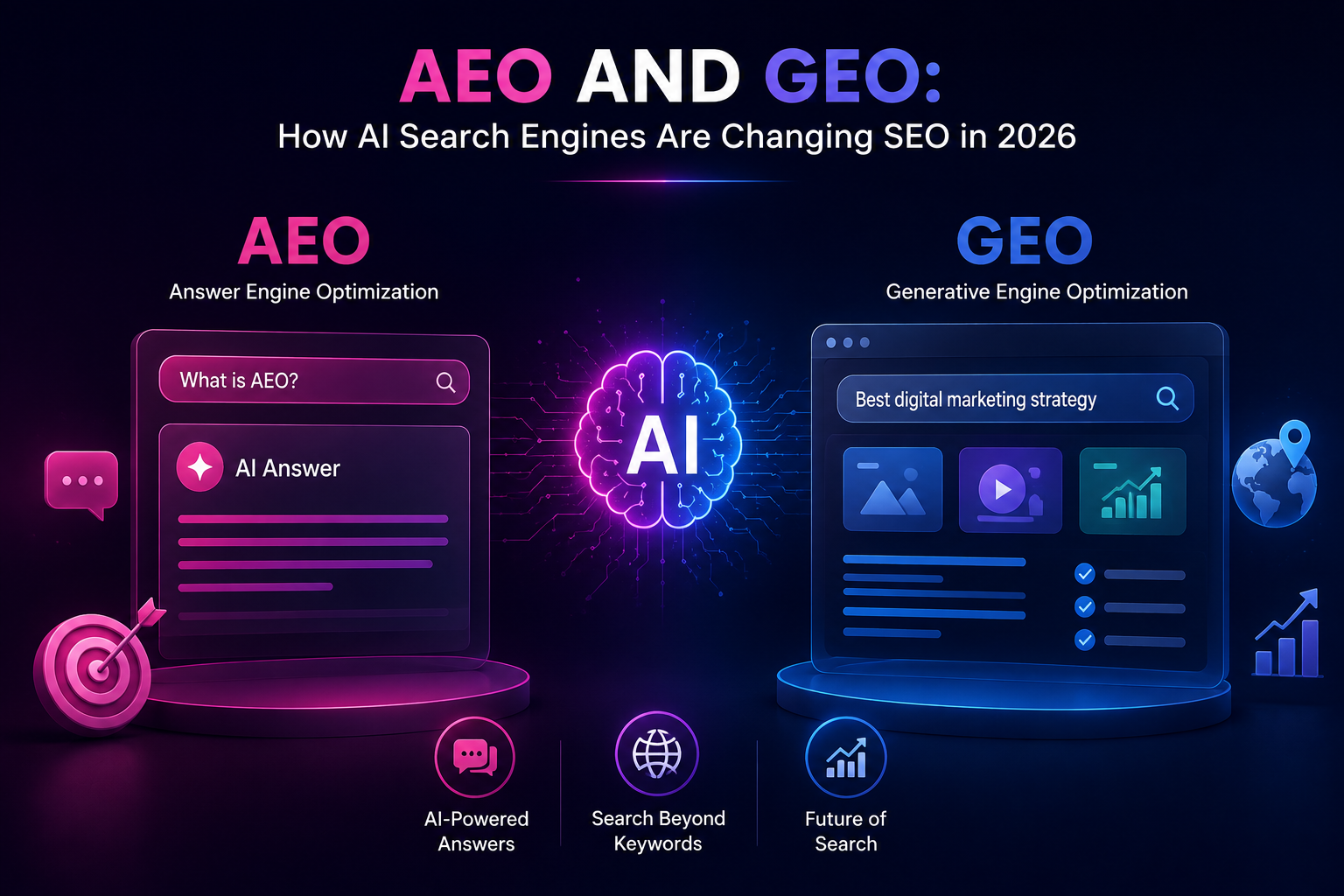
AEO and GEO: How AI Search Engines Are Changing SEO in 2026
AI Search Engine Optimization is changing how businesses appear in search results in 2026. An awkward thing took place in SEO in 2026. A user searches “best CRM for small business” on Google, but rather than getting ten blue links he could click on, he gets a machine-written answer to the query, which gives him the names of three products with sources. The person got his answer without clicking on a single website. Your well-optimized page ranked third, and nobody clicked through to it.
Meet the zero-click search era. More than sixty percent of all Google searches don’t include a click to a website at all. ChatGPT gets more than seven hundred million queries weekly. Perplexity, Gemini, Copilot, and Claude answer the questions that would have sent users to your website previously. Gartner’s prediction about the decline of traditional search volume by twenty-five percent in 2026 is coming true.
If your digital marketing strategy relies solely on rankings on Google SERPs, you are optimizing the system that is currently being rebuilt under your feet. AI search engine optimization is not an option anymore. It is the field that decides whether your company will appear in the answers replacing the links.
What Changed? What does AEO/GEO really mean? This guide explains the changes, what AEO and GEO really mean, and how you should react, all written for business owners and marketing managers, not SEO professionals.
The Three Disciplines You Need to Understand
Before 2024, there was one discipline: SEO. By 2026, there will be three disciplines, and they will complement each other rather than replace each other.
SEO: Ranking Pages in Search Results
Classic SEO is all about getting your pages to rank higher in the results of search engines. You find out what keywords to use, you create content, create links and optimize speed, and earn your spot in the rankings. That is still important. Google Search made sixty billion dollars in Q1 2026, a growth of nineteen percent from a year ago, with the number of queries reaching a new peak. Search is not dying. It is being reorganized.
AEO: Being the Extracted Answer
Answer Engine Optimization is the technique of organizing your content so that it is easily extractable by AI-enabled search engines and voice assistants to be presented as an answer. When Google presents an AI Overview at the top of its result page, where did that content come from? Answer Engine Optimization is how you make yourself that source.
By 2026, AEO goes beyond the traditional featured snippets into Google AI Overviews (fifty percent of US searches), ChatGPT/Perplexity conversations, and Siri/Alexa/Google Assistant voice search outputs.
GEO: Being Cited Inside AI-Generated Responses
What is generative engine optimization? It is the practice of ensuring that AI models cite, refer to, and recommend your brand as part of their answer generation process. As opposed to AEO, where the idea is to be cited as the answer from an individual piece of content, GEO operates on a broader scale – on building authority and consistency of your brand across multiple platforms.
The easiest way to separate the three concepts is as follows: SEO ensures your page can rank, AEO – that your content can be cited as an answer, and GEO – that your brand can be mentioned in AI-generated answers.
AEO vs SEO: What Actually Changed?
This is the core difference here: traditional SEO works under the assumption that a user would need to visit your website to receive an answer. AEO works on the assumption that they would not. The answer would be provided directly,y either via search results or an AI chatbot, and if your content does not work as the answer to be extracted, you would be invisible regardless of how good your rankings are.
Let me illustrate that idea with an example. User searches “How long does it take to build a mobile app?” Under the old scheme, the user clicks on one of the top results, reads an article, and possibly turns into a lead for the agency that created that article. Under the 2026 scheme, Google’s AI Overview compiles an answer from various sources and provides the answer directly: “Simple app takes three to four months, mid-complexity takes four to six months, complex apps six to twelve months.” The user received an answer. No clicking required.
SEO vs AEO does not involve selecting either. The SEO groundwork (good content, technical strength, domain authority, backlinks) ensures that your content becomes eligible for selection by the AI to use as the answer source. While the SEO groundwork will ensure your content ranks highly, you still require AEO, which provides the structure that allows your content to be extracted, summarized, and used by the AI system. If your content is not SEO optimized, it will never become part of the consideration set.
GEO vs SEO: A Different Game Entirely
While AEO vs SEO is the question of becoming the answer, GEO vs SEO is all about becoming the recommendation.
If ChatGPT is asked “what is the best web development agency for healthcare startups,” the answer is not based on any particular ranking that is taken from a webpage. It is built based on the patterns in the training data of the AI model, live search results, and the brand signals that the AI model associates with authority in the particular topic.
In GEO, we are talking about creating these patterns. GEO is 80% strategic (positioning, mentions in authoritative sources, consistent information about the brand, ecosystem), and 20% technical (schema markup, structured data, entity disambiguation). The brands featured in the AI recommendations are the ones mentioned consistently in all the sources used by the AI models to learn: publications, review sites, ecosystems, high-authority content.
This is a totally new optimization problem compared to classic SEO techniques. There is no way you can manipulate your way to success with the use of keywords. You build this reputation through true authority and persistence.
ChatGPT SEO Optimization: What It Actually Means
“ChatGPT SEO” has become a very popular keyword, but the question being asked is how to ensure that your business appears whenever ChatGPT is queried about the recommended options within your niche.
The truth of the matter is that there is no way of ensuring that you appear in ChatGPT recommendations (if anybody tells you that, then they are selling something fake). The only thing you can do is improve the chances of appearing by comprehending how ChatGPT works and comes up with its recommendations. Three key factors influence the results returned by ChatGPT – training data (all that it learned during model training until the knowledge cutoff date), web searches done by ChatGPT (currently, ChatGPT performs web searches), and brand consistency.
SEO for ChatGPT involves having consistent information related to your brand on your site, review pages, industry directories, and partner sites. SEO for ChatGPT involves being cited in relevant industry content through case studies and articles. For large enough brands, this includes having a Wikipedia page or other kind of entity description. Additionally, it involves crafting content that answers the questions that potential customers are asking, in a format that can be easily extracted by AI systems.
The Princeton GEO study identified certain practices in the use of content that increase AI citations by forty-one percent – including expert quotes, by thirty percent – including statistics, and by thirty percent – including source citations. This is not SEO but credibility signals that are considered by AI systems when citing sources.
AI Search Engine Optimization for Different
Various types of content require a different approach to AI search engine optimization because AI answer engines have unique mechanisms for extracting and providing information.
In the case of product/service pages, AI search engine optimization will require the implementation of structured data (Product schema, FAQ schema) and clear and extractable descriptions of the product itself, its target audience, purpose, advantages, and comparison with similar products. In the case of selection of the product for recommendation by AI engines, specificity plays an important role: for example, if the page says “CRM for twenty people’s consulting company with HubSpot integration,” it has more chances of being used than “CRM for all types of businesses.”
As far as blog posts and educational articles are concerned, AI search engine optimization will involve creating direct answer blocks at the beginning of each block and headings in the form of questions which could match the AI conversational queries, as well as statistics cited in the content that give the AI engines confidence in the information they provide. As for case studies and portfolio pages, AI search engine optimization will include entity relations, i.e, connecting the brand with the mentioned clients, technologies, and industries.
Answer Engine Optimization AEO Strategies for 2026
This is how the practical strategies that businesses can implement now would be described to marketing managers and business owners, and not technical SEO experts.
Structure Content Around Direct Answers
All content items on your website need to have an answer to a particular question in the first two paragraphs. The AI looks for answers that are concise and factual. A paragraph that gives an answer to a question like “how much does web development cost?” directly and specifically (“The cost of a professional business website is in the range of $8000-$25000 if built by a US company”) can be extracted. A paragraph saying “there are many factors involved, and we shall explore them below” cannot be extracted.
Implement FAQ Schema on Every Key Page
FAQ structured data (Schema.org FAQ markup) gives an AI system information about which questions your content is answering and where the answers can be found on your page. Web pages that feature Schema.org FAQ markup get featured in AI Overviews much more often than others, since the AI does not have to guess which question is being answered by your content.
Build Entity Authority, Not Just Page Authority
The AI systems will first identify your brand as an entity (as a business entity of a certain kind in a particular category) before determining keyword relevance. It is therefore important to ensure that entity information about your brand is consistent on your website, Google My Business page, LinkedIn, Crunchbase, industry directories, and Schema markup since that is how AI systems know what your brand is and what category it falls under.
Create Content That Earns Citations
The machine learning algorithm recognizes your brand as an entity, which is an organization of a certain kind in a particular category, before assessing the relevance of the keywords. The uniformity of your brand entity data on your website, Google My Business, LinkedIn, Crunchbase, and schema makes it easier for AI to know what your brand is and in which category it is placed, and that is essential when it comes to category-level queries such as “best web development agencies” or “top healthcare AI companies.”
Optimise for the Questions AI Systems Actually Receive
Queries typed into ChatGPT and Perplexity are not the same as the keywords typed into Google. Queries asked to AI are usually more specific and detailed: “What CRM should a ten-person consulting firm use if they need HubSpot integration and their budget is below two hundred dollars per month” rather than “best CRM for small business.” By writing answers to such specific queries, you increase the likelihood of being chosen as the source.
How Businesses Can Improve Answer Engine Optimization in 2026
For all business owners out there who are looking for how to get started, here is the order of priorities.
Priority One: Audit Your Existing Content for Extractability
Take your top twenty pages and think about this: if an AI was able to analyze this page, would it be able to come up with a specific answer to the question posed on the page? If the answer is hidden among three hundred words of introduction, if it is not specific but vague, or if you have to read the whole page in order to understand the answer, there is room for improvement.
Priority Two: Add Structured Data to Your Key Pages
Implement schema markup for FAQ, Organization, Product, and HowTo on pages which are important for your business. This is a technical process that any web developer can do within a couple of hours. It significantly raises the chances that the AI systems will pick up your content for answering the queries.
Priority Three: Build Cross-Platform Brand Consistency
Make sure that your brand name, description, category, and key claims are the same on your website, Google My Business, LinkedIn, Clutch, GoodFirms, Crunchbase, and any relevant industry directory. Since AI algorithms learn about entities from multiple sources, inconsistencies dilute your entity signal.
Priority Four: Create Original, Citable Content
Create content that features original data, original opinions, and original assertions that AI algorithms will want to cite. Case studies featuring specific figures, original research featuring verifiable statistics, and opinion pieces by experts with proper attribution are the type of content that is sought after for citations by AI algorithms. The generic “ultimate guides” that regurgitate other source material without providing original insights are becoming more and more invisible to AI answer engines.
Tracking Your AI Search Engine Optimization Results in 2026
The value of your work on AI search engine optimization lies solely in its measurability. Whereas classic SEO has access to Google Search Console statistics on ranking, AI search optimization requires completely new methods of measurement.
The only practical solution to measure the effects of your AI search engine optimization efforts in 2026 lies in testing across several AI platforms. Search for yourself, your product category, and your competitors via ChatGPT, Perplexity, Gemini, and Microsoft Copilot at least once per month. See if your brand mentions show up, in which context,t and how they are presented. Emerging solutions such as Otterly.ai, Peec AI and Profound will allow you to test AI search engine optimization on AI search engines by tracking mentions of your brand in conversations.
For AI search engine optimization, the only metric that matters is citation frequency – how often AI search engines cite your content in answers to relevant queries in your sphere. To increase citation frequency, you will need to apply all those methods and techniques that help boost traditional SEO, alongside structured data and entity consistency, which is particularly important for AI search engines.
Common AI Search Engine Optimization Mistakes to Avoid
Three common mistakes sabotage AI search engine optimization efforts despite having high-quality underlying content.
The first mistake is optimising the content for AI and not for people. Overusing schema and creating robotic answers that pass AI extraction requirements but are hard to read by people will lead to poor engagement metrics that are used by AI engines to define the content quality. A proper AI search engine optimization must enhance the reading experience, not destroy it.
The second mistake is failing to consider entity consistency between different platforms. The description of your brand on your website is one thing, while on LinkedIn it is another; and the Clutch profile says yet another story, and your Google Business Profile – yet another one. AI engines will lower the confidence level in citing your brand due to inconsistency in entities. Fixing the problem is often the most impactful step in the AI search engine optimization process and does not require spending any money.
The third mistake is trying to get AI placement guarantees from companies that promise you something like ChatGPT or Perplexity placements in return for money. No company can influence the recommendations of an AI engine. AI search engine optimization builds your reputation, consistency, and content quality, which increase the chances of being cited in the long run.
Should You Hire Generative Engine Optimization Services?
There has been a huge growth in the business of answer engine optimization and generative engine optimization in 2026, but everything is not above board. Below is how you can determine whether you require professional help and avoid falling prey to the scams.
When It Makes Sense to Hire Help
If your company relies on organic search and your traffic is dropping even though your rankings are stable or getting better, then your trouble is zero-click search stealing your traffic, and AEO/GEO optimization could be the solution you need. If you are in a competitive industry where AI-driven recommendations determine the purchase decision (SaaS, professional services, eCommerce), then GEO visibility is a competitive advantage for you.
Red Flags to Watch For
Promises to deliver placement on ChatGPT, Perplexity, or Google AI Overview are fraudulent. It’s not possible to guarantee any kind of AI placement because AI placement is determined by factors such as content quality, authority, and brand presence. But there is no way that anyone can determine how the AI model will generate its output.
It’s a scam when a company claims to be offering their “proprietary SEO technology for AI.” AEO and GEO techniques have been thoroughly detailed and include using structured data, entity optimisation, content restructuring, authority building, and consistency across all platforms. A reputable firm will explain their technique.
What Legitimate Services Actually Provide
Real-world generative engine optimization consists of AI visibility audits (tests that show where your brand is visible on ChatGPT, Perplexity, Gemini, Copilot, and Google AI Overviews), content restructuring to help extract answers, use of schema markup, entity optimization on all platforms, and monitoring of AI citation rates. Good services incorporate these techniques into your SEO plan without disrupting it.